

How do you bring a pharaoh to life?
- 5 min.
- Entertainment

The making of.... Tutankhamun: The immersive exhibition
More than a century ago, Howard Carter embarked on a crazy adventure in search of the unknown tomb of a pharaoh. Result: Tutankhamun conquered the world. This event inspired a small team in Madrid to recklessly set to work with the secrets of Ancient Egypt and its young king. Result: Tutankhamun – The Immersive Exhibition.
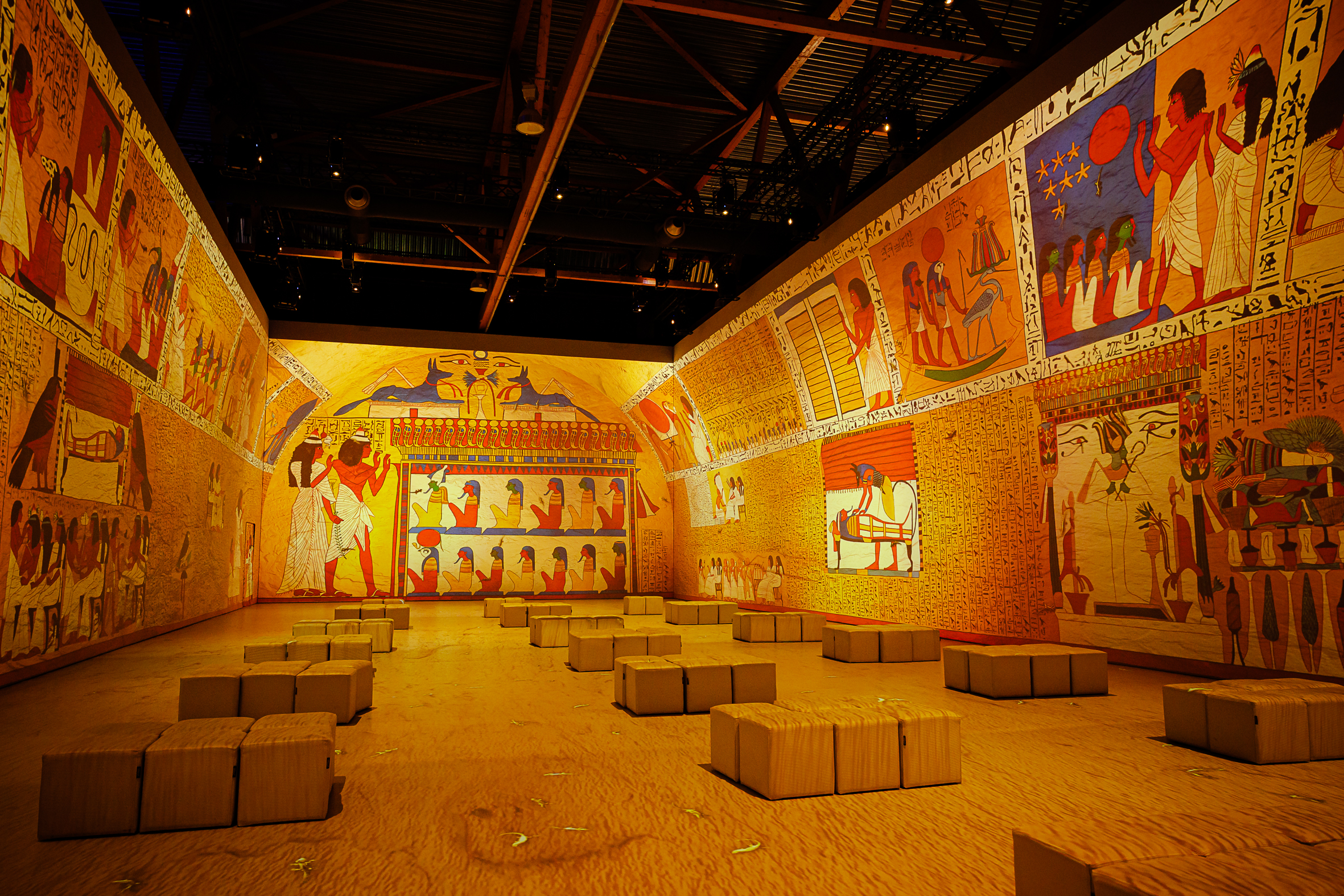
This immersive exhibition has been running in Terminal 1 of Brussels Expo since May 23. Visitors walk through an eight-metre-high tomb, look into the afterlife via virtual reality, and hear the real voice of Howard Carter echoing among the projections. What few people know is that this all started as a gamble by that small group of creatives in Madrid who had never created anything like it before. Jelle de Jong, CEO of Madrid Artes Digitales and the originator of the production, tells how an unknown start-up grew into one of the best-viewed immersive experiences in the world.
A theatre piece for the senses
In the early '20s, the use of virtual reality and AI was still in its infancy. The public was mainly familiar with projected art shows such as those about Van Gogh. Never before had an existing story been told, an entire world created. Their approach was: to treat the exhibition as a theatre piece. Both the dramaturgy of the narrative and that of the visitor during their journey through the story play a leading role in this.
Jelle explains: 'Someone walks in, lets go of daily worries, steps into a dark space, and is first stimulated with text. From there, the team looked for ways to surprise the visitor digitally again and again, without losing the underlying story.'
Craftsmanship
An experienced theatre and filmmaker himself, he worked with a dramaturge, an Egyptologist, and a historian to build the different spaces. For a year and a half, a small team initially worked on writing it out. Afterwards, no fewer than fifty animators set to work drawing all the animations. 'I know we live in a world of AI and many digital assets are made with AI these days. Within our world and our experience, the craftsman's craft was implemented in all elements, even though you are in a digital world. The only artificial intelligence within the exhibition is a gimmick at the end, the photo booth in which you are morphed into an Egyptian of yesteryear,' says Jelle.
You cannot get a performance, projection or VR with a beating heart and a soul if you do not build it yourself, image by image, frame by frame, composition by composition, note by note, with people who have experience, feeling, and a connection with the subject. – Jelle de Jong, CEO Madrid Artes Digitales
Music also plays a leading role in the creative process. No synthetic sounds, but real musicians, real choral parts, and real singers, supplemented with the authentic voice of Howard Carter. The final production time was about seven or eight months.
With the compliments of the current 'pharaohs'
When the exhibition first played in Madrid almost four years ago, it immediately caught on: full houses for eight months, 330,000 visitors, and queues outside the door. And Jelle got a call from the Grand Egyptian Museum for a coffee meeting. Amr Abdelnasser, Director Special Exhibitions GEM - Legacy, came to see the projection film after closing hours, without an audience. That is the 360-degree projection, in which impressive images on walls and floor tell the story of Egyptian civilization and Tutankhamun. The projection room remained silent for thirty minutes. He asked to see it two more times. After that, he rebooked his flight and watched it again with a colleague. It turned out that the museum had been looking for exactly such an experience for the period before the official opening.
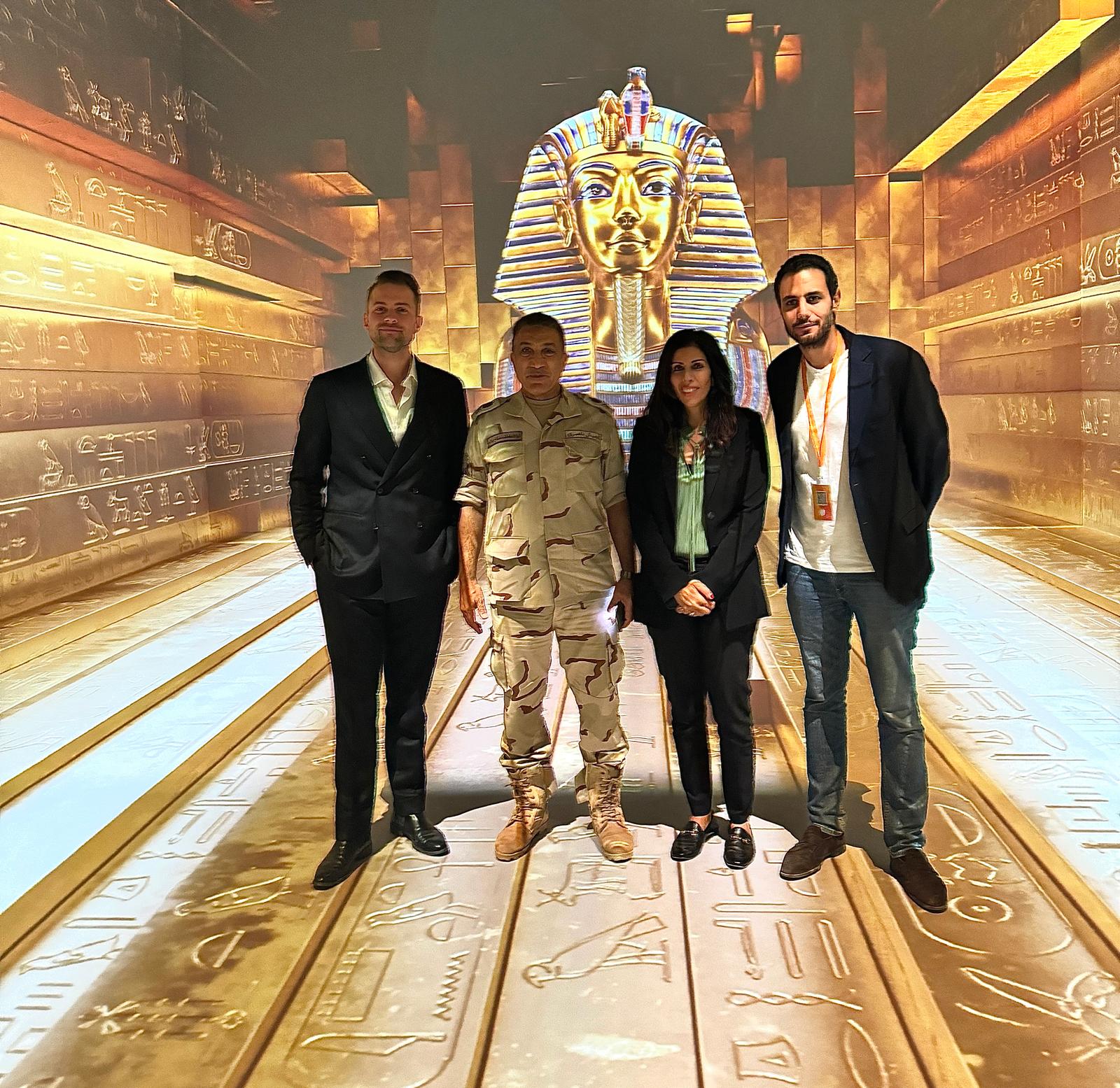 Jelle de Jong - CEO MAD / Major General Atef Moftah - Engineering Supervisor GEM / Merette Elsayed - CEO Legacy / Amr Abdelnasser - Director Special Exhibitions GEM - Legacy
The MAD team set to work to recreate the immersive space of their exhibition in the museum in three months. Eventually, they had that room up and running and the film was ready. There was an Arabic voice-over, a translation, and a pre-show with texts. Major General Atef Moftah - Engineering Supervisor GEM, then came to take a look and give his blessing. 'That was such an exciting moment,' Jelle remembers. 'What if he wasn't satisfied? When he finished he said: We have to change one thing. And I thought: here it comes. In that opening scene, he said, when Tutankhamun's eyes open at that mask, we have to change the color of that. I said: let's do that, and thought to myself: if that's all it is.'
The film ran there for six months, 98 percent occupied every day. For Jelle, this experience was the golden crown on their work and a huge reward for the team and everyone involved.
From gamble to classic
Today, the production is experiencing its twentieth premiere worldwide and has attracted more than 2.5 million visitors, from Madrid to Cairo, from Hamburg to Birmingham – and now also Brussels. Jelle likes to compare the status of the show with a classic from the ballet world.
Just as you have Swan Lake in the ballet world, you have the Tutankhamun of Madrid Artes Digitales in the immersive world. – Jelle de Jong, CEO MAD
Exactly 100 years to the day – Tutankhamun: The Immersive Exhibition opened its doors to the public on November 4, 2022 in Madrid – after the legend of Tutankhamun began with the discovery of his tomb, MAD virtually brought the young pharaoh back to life. The whole project was a gamble, just like Carter's quest was. The exhibition has lost none of its power and beauty in that time. At the opening in Brussels, the Ambassador of Egypt, Ahmed Abu Zeid, was personally present to officially open and inaugurate the exhibition. During his opening speech, the ambassador emphasized the enduring relevance of the ancient Egyptian civilization and praised the way modern technologies, such as virtual reality and the metaverse, bring history to life for new generations.
The exhibition, spread over more than 2,500 square meters in Terminal 1 of Brussels Expo, can be visited until 9 November. Info & tickets.


