

Run away with the circus
- 7 min.
- Entertainment

From an Antwerp gym to the world stage
When his mother took him to toddler gymnastics at the age of two and a half, no one had any idea that this child would ever fly across a gigantic stage as a cricket worldwide. Yet that is exactly what is happening. From 30 September to 4 October 2026, Cirque du Soleil will bring its updated show OVO to the ING Arena in Brussels, featuring Belgian Jorn De Laender as one of the tumblers.
Building a career at Cirque du Soleil is – to put it mildly – something special. From the first somersaults in the gymnastics hall to a life on stage, OVO acrobat Jorn De Laender guides us through his story.
The call of the circus
At the age of twelve, he definitively chooses tumbling: jumping, spinning, flying over a long, springy track. By the age of fifteen, he is already training at international level as a member of the Belgian national tumbling team. The logical next step is the top-level sports school in Ghent and training to become an English and physical education teacher.
Gradually, he sees how fellow tumblers leave for Cirque du Soleil one by one and realises that the circus could offer a real professional future. At least if he wants to continue tumbling after the competition period. The question is no longer whether he would follow that path, but how he himself can take the step.
He thoroughly researches the system: do you earn enough, what about insurance, is it realistic? 'Those were questions that came from my mother,' he laughs. In any case: 'I can also do everything they do in the shows,' Jorn knows. So he creates a casting profile on the Cirque du Soleil website. That site asks for a CV, a video with skills, a strength and flexibility test, a piece of self-presentation for the camera, and even a little dance.
Meanwhile, the young gymnast switches from tumbling to artistic gymnastics and puts the call of the circus on hold for a while.
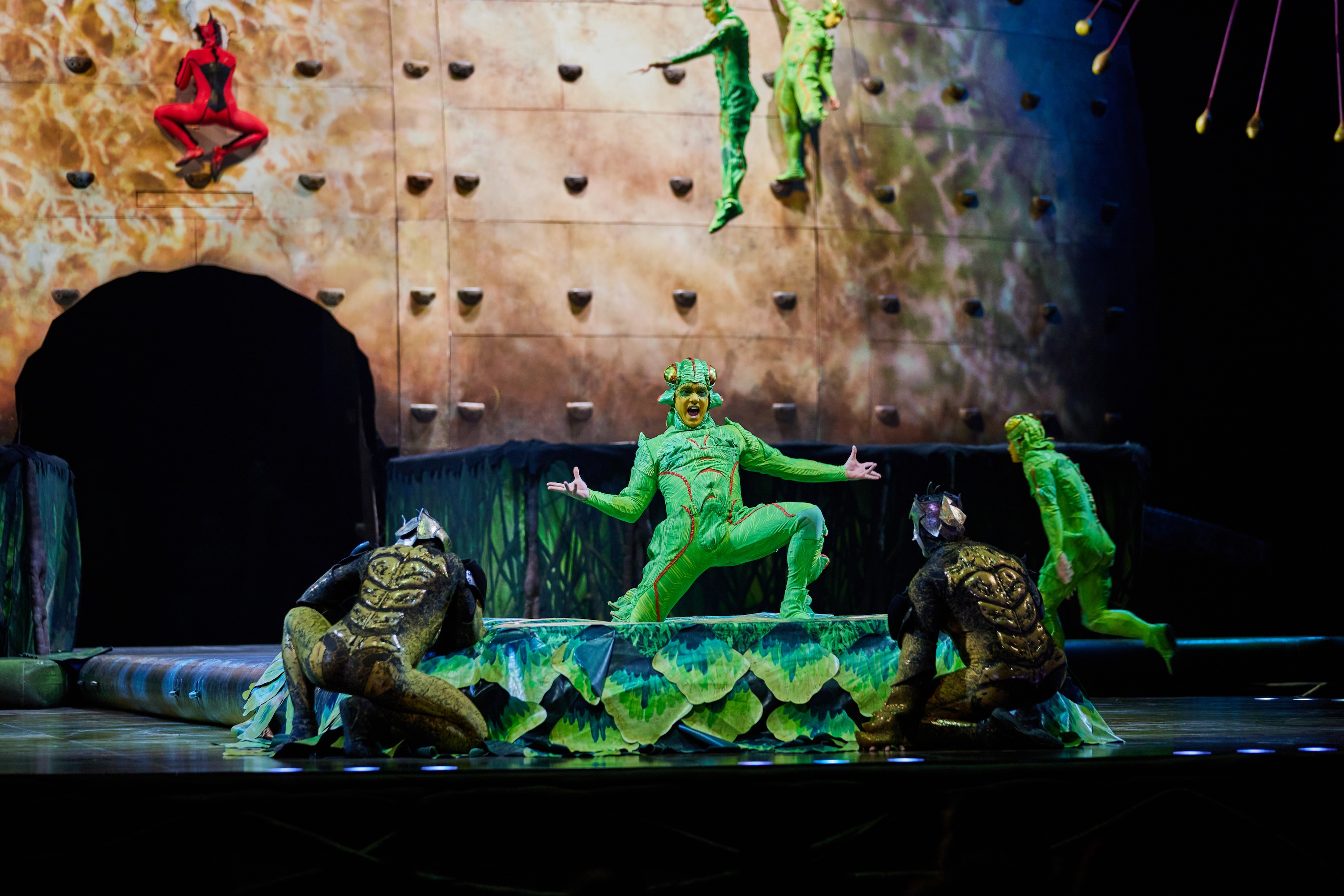
Auditioning
But then an open audition comes up in Paris. Jorn goes there alone. He has to show the same elements as online, along with an on-site learned choreography and something he doesn't expect: courage. There is improvisation. A bit of clowning. 'It's not about being a clown,' he explains, 'but about daring. That was a part they wanted to see.'
He passes the audition with flying colours and ends up in the Cirque du Soleil database. After that: waiting. For a year, until a suitable role becomes available for his profile, resulting in a call from Montréal.
Getting used to the magic
In April 2015, Jorn joins LA NOUBA, the resident show in Orlando. 'Quite intimidating,' he says openly. 'You know the name. You've seen the shows. To suddenly enter such a large professional company – you don't really know what to expect.'
Cirque du Soleil understands that. New artists don't immediately start with their heaviest stunts. The new artist trains along to learn the act and to gain stage acclimatisation thanks to the cues. 'Cues are other pieces within the show that you do: a piece in the background during another act, helping to set up, move something, a piece of choreography in the background or sitting still as part of the act,' Jorn continues. 'They give you the opportunity to first get used to what it is like to be on a stage in front of so many people.' Only when the artist indicates they are ready does the responsibility increase.
After a number of temporary contracts in Orlando, he decides to temporarily step back. Life alone in another country, far from family and friends, weighs heavier than expected. 'I loved the job. I would like to come back. But I needed some time for myself.' And Cirque respects that. A few months later he indicates that he is ready for a travelling show.
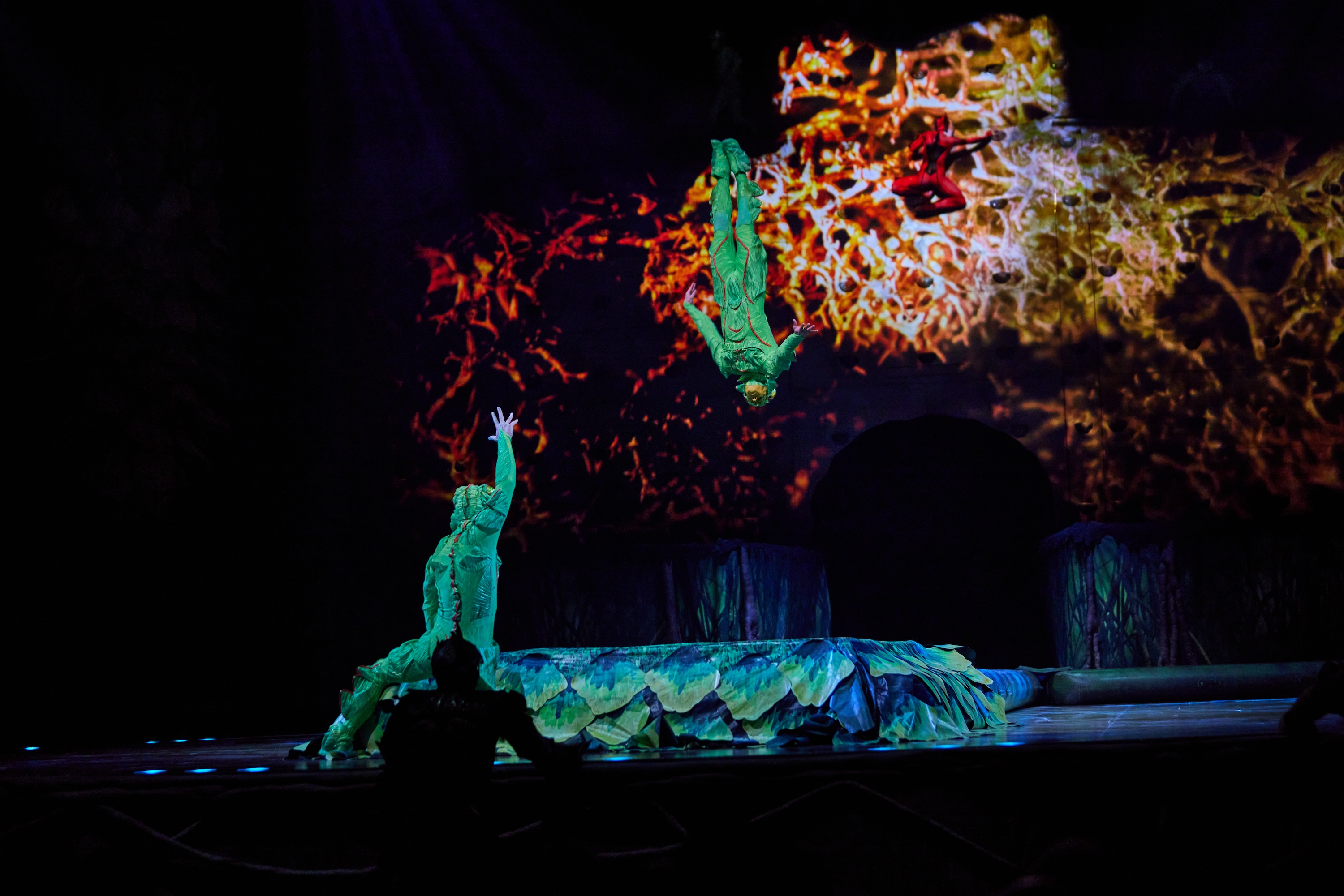
OVO
And at that moment, a place becomes available at OVO, the colourful insect show that will soon land in the ING Arena in Brussels. This time, a permanent contract immediately follows because he had already proven that he could handle the work and knew exactly what he was getting into. Since 2017, Jorn has been part of the colourful and acrobatic insect colony.
His main character is the cricket. Occasionally he sneaks into the costume of a mischievous mosquito on stilts. And since 2019, he is also a back-up for 'The Voyager', a spiky and comical blue flying character – a theatrical expansion that also pushes him outside his athletic comfort zone.
OVO is not a static spectacle: the show premiered in the circus tent in 2009, was completely reworked into an arena spectacle in 2016 and recently received another thorough update. Jorn witnessed closely how OVO was given a new look in 2024. Decor, music, lighting and even certain acts were adapted, so that the insect universe looks even more colourful and modern. The tumbling act also got different music, which brings a completely different feeling for the acrobats.
OVO also has another Belgian link besides Jorn. The decor includes a series of monumental leaves as a moving backdrop, designed by the Belgian company WICREATIONS.
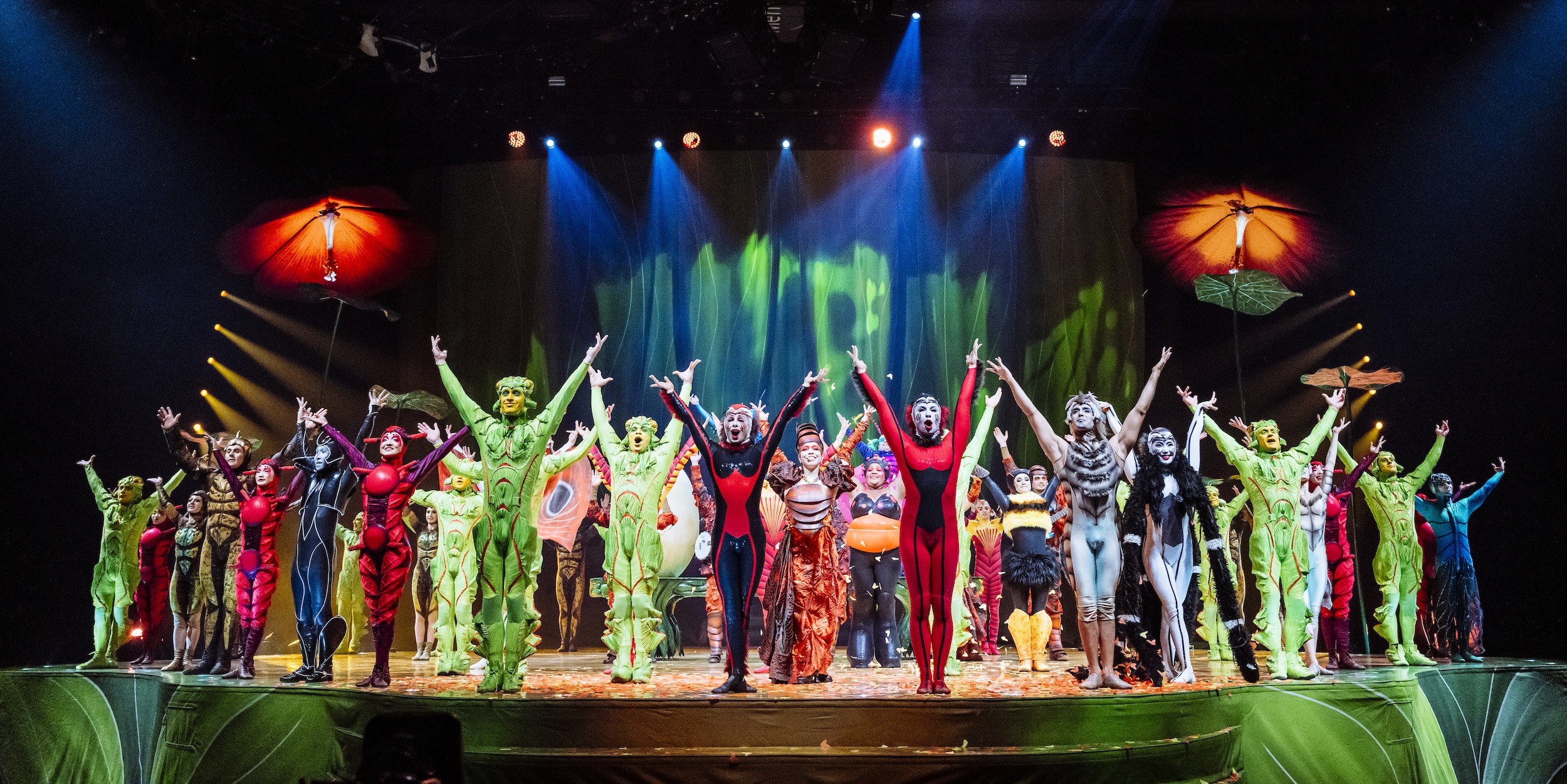
Life on tour
Behind the shiny costumes is a strict rhythm. OVO, as an arena show, travels to a different city almost every week, which means that the artists are constantly on the road, performing, training and discovering new environments in the meantime. Jorn uses his free hours to walk through the host cities, play board games, watch anime or visit a climbing gym – ways to relax mentally between performances.
A logical question: does an act become dangerous if you know it too well after years? Jorn shakes his head. 'We have constant rotation. Every show we rotate what we do. You never know exactly what will happen, so you stay focused. Even if you know the act inside out, there is always stress, nervousness. That keeps you alert.'
Injuries are part of it, even at the top of acrobatics. Cirque du Soleil has two physiotherapists per show, full insurance and the logistics to arrange medical assistance anywhere in the world. Rehabilitation can be at home or at the headquarters in Montréal, in consultation with the artist. 'They take good care of us,' Jorn says simply. 'That is one of the strengths of Cirque du Soleil.
What after the last jump?
The shelf life of a career at Cirque du Soleil differs per discipline. 'My discipline has a heavy impact on the body. I will be 36 in October and it is slowly starting to get heavier and heavier. There are other disciplines where the impact on the body is less severe, which allows them to keep going longer. We just celebrated Wellington at OVO, who has been an acrobat at Cirque du Soleil for 25 years. That is incredibly long.'
As long as he is physically and mentally ready to jump, Jorn continues to put all his energy into that one goal: to keep performing and astonishing the audience. Stopping is not on his agenda, but evolving is. 'My focus is on: what can I do to stay on stage? I enjoy being on stage and performing. Even if it is less impactful or acrobatic, such as a character role, or a clown. Something that is less demanding on my body, but mainly keeps me on stage.' That clown role as back-up for The Voyager is not entirely coincidental...
At the same time, he sees how colleagues find their own path: as a coach at Cirque or in a national team, as a technician behind the scenes, or with their own creative project that builds on the experience in the tent. A career at Cirque du Soleil rarely stops abruptly; it transforms, just as OVO itself constantly changes its form.
So, when you are in the hall in Brussels when OVO lands, Jorn's graceful jumps are not only the result of years of training, but also of a thoughtful organisational structure within Cirque du Soleil that seeks, trains, protects and grows talent – far beyond the last somersault.
Cirque du Soleil's OVO — ING Arena Brussels, 30 September – 4 October 2026. Tickets.


